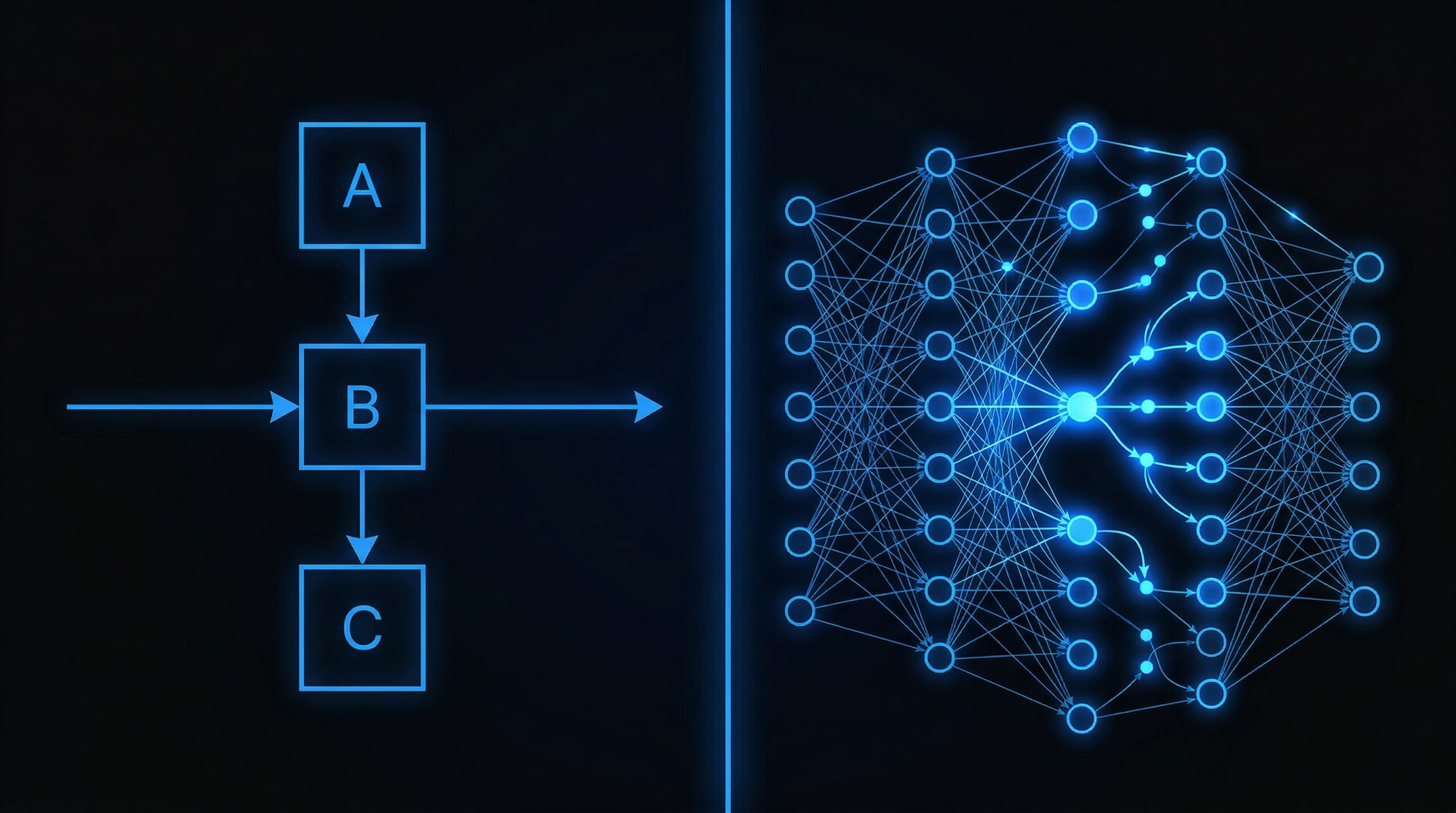
Every week I talk to business owners who want "an AI agent." Half the time, what they actually need is a simple automated flow. The other half already have flows and are frustrated they can't handle anything unexpected. The skill is knowing which one fits your problem.
The simple version
A flow is a fixed path. Step A leads to Step B leads to Step C. Always the same. Predictable. Like a recipe — follow the steps, get the result. No surprises, no judgment calls.
An agent is AI that makes decisions. It looks at the situation, picks from available tools, and figures out the next step on its own. Like a junior employee who knows where to find answers — you give a goal, not a script.
That's it. Everything else in this article is just helping you figure out which one you need.
When a flow is all you need
Flows work brilliantly when:
- The task is repetitive and rule-based
- The data format is always the same
- You want 100% predictability
- There are no judgment calls involved
Examples: invoice processing, email forwarding rules, report generation, data backup, file sorting, scheduled notifications.
If you can describe the entire process as a flowchart with no decision diamonds, you need a flow, not an agent. Flows are cheaper to build, easier to maintain, and never surprise you.
When you actually need an agent
Agents earn their keep when:
- Data comes in different formats every time
- The task requires understanding context
- Decisions depend on information that changes
- The process can't be drawn as a straight line
Examples: customer support with varied questions, document analysis across different formats, lead qualification requiring nuanced judgment, contract review where clauses vary wildly.
If the task requires reading, understanding, and making a judgment call — that's agent territory. No amount of if/else branching in a flow will replicate genuine comprehension.
The human-in-the-loop spectrum
Not every agent needs to run fully unsupervised. There's a spectrum, and where you land depends on the risk level of the task:
| Level | Description | Example |
|---|---|---|
| Human-in-the-loop | AI prepares, human decides | Email drafts queued for client review |
| Human-on-the-loop | AI acts, human monitors | Automated report generation with spot checks |
| Fully autonomous | AI acts without oversight | Internal data processing and file organisation |
Sensitive tasks — client-facing emails, financial decisions, anything with legal implications — should always have human-in-the-loop. Internal, low-risk tasks can be more autonomous. Start supervised, loosen the reins as trust builds.
The expensive mistake
Businesses waste money in two directions. They build agents when a simple flow would do — overengineering a problem that doesn't need intelligence. And they waste time using flows when they need an agent — forcing rigid automation onto tasks that require flexibility.
I've seen a company spend thousands on an "AI agent" for invoice processing that never varied in format. A flow would have cost a fraction. I've also seen teams spend months trying to build flow-based customer support that collapsed the moment a question didn't match a template.
How to decide
Four questions. That's all it takes:
- Is the process identical every time? Flow.
- Does it require judgment? Agent.
- Can you draw it as a straight-line flowchart? Flow.
- Does the AI need to adapt to new situations? Agent.
If you answered "flow" to all four, build a flow and save your budget. If even one answer points to "agent," you likely need at least a hybrid approach.
Sources: Kuba Mrugalski (Mikrus/AIDevs), practical AI agent implementation patterns, 2026. Deployed automation patterns across UK service businesses.
Not sure which approach fits your process?
Fortnight & Co builds working AI systems for UK service businesses in 14 days. We'll tell you whether you need a flow, an agent, or something simpler.
Get your free automation auditFree - 20 minutes - No obligation - Custom report